


 PLATFORM UPDATE:


In situ hydrogen production in all-level-humidity air: integrating atmospheric water harvesting with photocatalysis†

Abstract
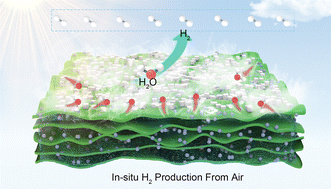
H2 production from air holds great promise as a sustainable method for green energy harvesting. However, its widespread adoption faces challenges in realizing mobile, distributed, community-managed, off-grid in situ H2 production systems. Here, we report a bilayer nanofibrillated cellulose composite gel incorporating lithium chloride hygroscopic salt and a supported SrTiO3:Al photocatalyst (denoted as NLS), designed specifically for in situ photocatalytic splitting of atmospheric water to produce H2, using only naturally occurring moisture and sunlight. The NLS gel features a self-supply of atmospheric water, spectral splitting for efficient solar energy delivery and complementary utilization, instantaneous H2 evolution, and stable catalyst immobilization. As a result, the NLS bilayer gel successfully achieves in situ H2 production in full-range-humidity environments, demonstrating a hygroscopicity of 4.26 gH2O gsorbent−1 and an H2 production activity of 65.45 μmol h−1 in a 90% relative humidity environment, achieving a solar-to-hydrogen efficiency of up to 0.3%. This work represents a promising step towards realizing in situ H2 production from air across varying humidity levels, independent of geographical constraints.
- This article is part of the themed collection: Power-to-X and Solar-to-X Technologies for a Net-Zero Future
 Please wait while we load your content...


