


 PLATFORM UPDATE:

Optimizing sodium percarbonate oxidation for wastewater treatment with artificial intelligence
 *c
*c
Abstract
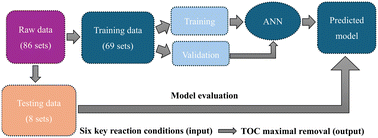
The effective removal of toxic pollutants like m-cresol from wastewater remains challenging despite technological advancements. This study optimized total organic carbon (TOC) removal from m-cresol-contaminated wastewater using sodium percarbonate (SPC) oxidation through artificial neural network (ANN) and response surface methodology (RSM) modeling. TOC was selected as the optimization target due to its comprehensive representation of organic pollution levels. Six operational parameters were evaluated: initial pH, reaction time, SPC dosage, temperature, catalyst dosage, and initial m-cresol concentration. The ANN model demonstrated superior performance over RSM, achieving near-perfect R2 values with significant improvement in predictive accuracy. Under optimal ANN-derived conditions (pH 2.3, 35.7 min, 2.9 g L−1 SPC, 45.7 °C, 12.9 g L−1 catalyst, 75 mg L−1m-cresol), maximum experimental TOC removal reached 67.8%, significantly exceeding RSM's 38.2%. These findings demonstrate ANN's superior capability to model complex, nonlinear relationships in advanced oxidation processes, providing a robust optimization framework for enhancing wastewater treatment efficiency.
- This article is part of the themed collection: Recent Open Access Articles - Environmental Science: Water Research & Technology
 Please wait while we load your content...


