


 PLATFORM UPDATE:

UV/O3 degradation of norfloxacin in complex lake and reservoir water matrices: performance, mechanisms, and pilot-scale verification

Abstract
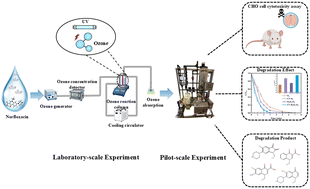
This study systematically compared four advanced oxidation processes (AOPs) for norfloxacin (NOR) degradation in aquatic systems: O3, O3/UV, O3/H2O2, and UV–H2O2/O3. The UV–H2O2/O3 system demonstrated the highest degradation efficiency, achieving 83.85% NOR removal within 1.5 minutes with a reaction rate constant 125.09% higher than O3 alone. Considering both economic feasibility and efficiency, the O3/UV system showed superior practical value, exhibiting an 82.56% higher pseudo-first-order reaction rate than standalone O3 treatment. The optimal operating conditions were determined to be an ozone concentration of 0.5 mg L−1 and UV fluence of 44 mJ cm−2. Radical scavenging experiments revealed that direct O3 oxidation contributed 31.47% to overall degradation. The ·OH exposure in the O3/UV system reached 3 × 10⁻¹⁰ mol L−1 s−1, representing an 8.98-fold increase over ozone treatment alone. LC–MS analysis coupled with DFT calculations identified four primary degradation pathways: piperazine ring cleavage, quinolone core ring-opening, decarboxylation/defluorination, and direct aromatic defluorination. Cytotoxicity assessment using CHO cells confirmed safety with >90% cell viability across all systems. Pilot-scale validation using real water matrices was conducted, achieving 84.21–90.34% NOR removal and significant UV254 (52.71–58.36%) and total organic carbon (TOC) (27.47–31.34%) reduction. Background water matrix composition, reactive radical generations, significantly influenced performance, with Yellow River water getting the highest treatment efficiency due to lower dissolved organic carbon and turbidity. This investigation bridges the gap between laboratory research and practical application, providing both mechanistic insights and practical solutions for antibiotic contamination control in aquatic environments.
- This article is part of the themed collection: HOT articles from Environmental Science: Water Research & Technology
 Please wait while we load your content...


