


 PLATFORM UPDATE:


Characterization and source apportionment of particulate matter and associated culturable bacterial bioaerosols at sites cultivating aromatic and medicinal plants
 *ab
*ab
Abstract
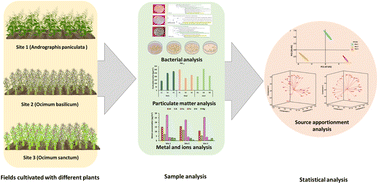
The atmospheric particulate matter (PM) and bioaerosol concentration in agricultural sites varied with agricultural activities and plantation type. In this study, the mass and elemental and ionic composition of PM10 and PM2.5 were examined at three agricultural sites cultivating Andrographis paniculata, Ocimum basilicum and Ocimum sanctum. The bacterial colony-forming units (CFU) and dominant bacterial species present in PM10 were also examined at three sites. PM10 concentrations ranged from 138.20 to 309.60 μg m−3, while PM2.5 varied between 50.05 and 165.15 μg m−3. Elemental analysis revealed the dominance of crustal elements (Ca, Al, and B) along with trace levels of heavy metals (Pb, Cr, and Cd), while the ionic composition was dominated by Ca2+, K+, NH4+, Cl−, SO42−, and NO3−, indicating agricultural and combustion-related sources. Source apportionment analysis revealed that PM2.5 was more influenced by secondary aerosols and combustion-related emissions, while PM10 was associated with biological and crustal components. Bioaerosol concentrations ranged from 5.87 to 7.11 log CFU m−3, with Bacillus sp., Pantoea sp., and Pseudomonas sp. identified as the dominant bacterial species. A significantly lower load of these bacterial species in bioaerosols at the site cultivating Ocimum sanctum was observed. Overall, the source apportionment demonstrates that agricultural activity is a key source of particulate matter and regulates the concentration of particulate matter in the air.
 Please wait while we load your content...


