


 PLATFORM UPDATE:


In situ 2D-perovskite-like ligands offer versatile passivation of large and small sized PbS quantum dots for infrared photovoltaics

Abstract
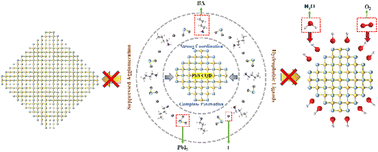
Solution-processed lead sulfide (PbS) colloidal quantum dots (CQDs) have emerged as promising optoelectronic materials due to their size-tunable optical bandgaps and multiple exciton generation. Short-chain lead iodide and halide perovskites demonstrated effective passivation of polar <111> facets with Pb atom-only termination. Yet they failed to sufficiently passivate non-polar <100> facets that exhibit S/Pb dual-terminations—prevalent in larger-sized CQDs. Moreover, their weak ionic nature renders them vulnerable to moisture and oxygen exposure. Here we introduce a robust 2D neat perovskite (BA)2PbI4 for surface engineering of PbS CQDs via an in situ solution-phase ligand-exchange strategy. Such treatment forms a thin shell of BA+ and I− ions on the CQD surface, especially on the challenging non-polar <100> facets, enabling strong inward coordination that effectively reduces surface defect density and prevents CQD aggregation and fusion. Infrared solar cells employing (BA)2PbI4-capped large-sized PbS CQDs (1.0 eV-bandgap) as active layers achieved an impressive power conversion efficiency (PCE) of 8.65% coupled with excellent ambient stability, attributed to the hydrophobic nature of the BA+-rich surface. The same ligand strategy also proved versatile for small-sized PbS CQDs (1.3 eV), yielding a champion PCE of 13.1% and significantly enhanced thermal stability in devices compared to the control device of PbI2-capped analogues (11.3%).
 Please wait while we load your content...


