


Ultra-low-loading RuW nanoclusters coupled with W single atoms for efficient anion exchange membrane fuel cells

Abstract
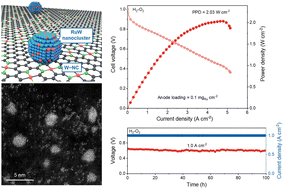
Cost-effective Ru holds promise to tackle the sluggish hydrogen oxidation reaction (HOR) kinetics under alkaline conditions and has emerged as an appealing alternative to Pt and Pt–Ru. However, developing Ru-type catalysts that can simultaneously possess high activity and stability for practical anion exchange membrane fuel cell (AEMFC) applications remains a significant challenge, particularly when using low platinum-group-metal (PGM) loadings. Here, we present a versatile dual tungsten (W)-embedding nanocatalyst that integrates dispersive Ru–W nanoclusters with W single atoms on a N-doped carbon (NC) substrate (RuW/W–NC). Specifically, W acts as both an activator for Ru nanoclusters and a stabilizer between Ru nanoclusters and the NC support to enhance the activity and durability. Importantly, the RuW/W–NC-based fuel cell with an ultralow Ru loading of 0.1 mg cm−2 achieves an exceptional peak power density of 2.03 W cm−2 in H2–O2, surpassing state-of-the-art Ru-based HOR catalysts and commercial Pt–Ru/C. Notably, the AEMFC delivers a rated power density of 0.91 W cm−2 at 0.65 V under H2–air conditions, approaching the U.S. Department of Energy (DOE) 2025 target (1 W cm−2) with a total PGM loading of 0.125 mg cm−2. Additionally, the RuW/W–NC-based fuel cell can be run stably at an industrial current density of 1 A cm−2 beyond 100 h. Detailed mechanistic and theoretical investigations reveal that the exceptional performance of RuW/W–NC originates from the embedment of W in Ru nanoclusters and the formation of interfacial Ru–W coordination, which effectively balances *OH and *H adsorption/desorption and inhibits agglomeration of nanoclusters, respectively. These ground-breaking milestones shed light on Ru-type catalysts, positioning RuW/W–NC as the most efficient HOR catalyst for practical cost-effective AEMFC applications.
 Please wait while we load your content...


