


 PLATFORM UPDATE:


Wavelength-resolved quantum yields for phenolic carbonyls in acidic solution: molecular structure effects on brown carbon photochemistry
 a
Greg T.
Drozd
*a
a
Greg T.
Drozd
*a
Abstract
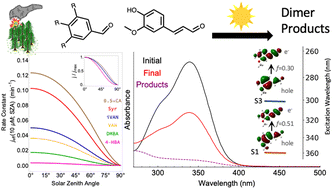
Light absorbing organic aerosol content, or brown carbon (BrC), affects climate through positive radiative forcing, may act as a photosensitizer in particle aging, and can directly play a role in the oxidative aging of organic aerosol. Wildfire emissions are a global source of BrC, and within wildfire emissions phenolic carbonyls (PhC) are some of the most photoreactive compounds emitted. Wildfire BrC components may have photochemical lifetimes of hours to days. Such a wide range in lifetimes makes detailed information on the products and mechanisms of BrC photochemistry critical in estimating effects of BrC on climate and aerosol chemistry. The aerosol chemical environment, particularly pH for aqueous aerosol, has strong effects on the reactivity of BrC, potentially altering absorption spectra and excited state reactivity. Various laboratory approximations of solar illumination have been used in studying the photochemistry of BrC compounds, making direct comparison between results difficult, and the relationship between chemical structure and reactivity of PhC is important for understanding and predicting BrC behavior and stability. In this work, aqueous photochemistry of six phenolic carbonyls (PhC) including coniferaldehyde (CA), 4-hydroxybenzaldehyde (4-HBA), 4-hydroxy-3,5-dimethylbenzaldehyde (DMBA), isovanillin (iVAN), vanillin (VAN), and syringaldehyde (SYR) was studied to elucidate relationships between structure, product formation, and photochemical mechanism. Using several narrow band UV-LEDs (295–400 nm), wavelength dependent quantum yields were calculated to allow direct comparison between photochemical experiments with laboratory irradiation sources and atmospheric actinic fluxes. Quantum yields were measured in acidic, air-saturated, aqueous solutions with pH = 2; conditions present in sulfate dominated aerosol or very acidic fog droplets. Computational results show that the electronic transitions leading to photochemical loss of PhC are nearly all π → π*, with conserved aspects of their electronic character. PhC photochemical quantum yields are concentration dependent, due to a direct reaction between triplet excited-state and ground-state PhC molecules, and maximum quantum yields of the range of structures studied span 0.05–2%. Wavelength dependent quantum yields are used to directly calculate the dependencies of photochemical loss on solar zenith angle (SZA).
 Please wait while we load your content...


