


 PLATFORM UPDATE:


Engineered mesoporous silica nanosystems with organotin(iv) complexes containing 1-(quinolin-8-yliminomethyl)naphthalen-2-ol ligand for cancer cell targeting
 ab
Robin
Vinck,
b
Javier
Álvarez-Conde,
a
Victoria
García-Almodóvar,
a
Sanjiv
Prashar,
ac
Gilles
Gasser
*b
and
Santiago
Gómez-Ruiz
*ac
ab
Robin
Vinck,
b
Javier
Álvarez-Conde,
a
Victoria
García-Almodóvar,
a
Sanjiv
Prashar,
ac
Gilles
Gasser
*b
and
Santiago
Gómez-Ruiz
*ac
Abstract
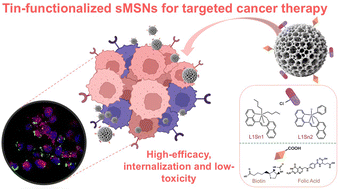
The development of targeted nanotherapeutics has emerged as a promising approach to improve the efficacy and safety of anticancer treatments. This manuscript presents the synthesis, detailed characterization, and biological evaluation of novel mesoporous silica nanoparticles (sMSNs) functionalized with organotin(IV) complexes containing 1-(quinolin-8-yliminomethyl)naphthalen-2-ol ligand, which have also been selectively targeted using biotin (BT) and folic acid (FA). The systems have been comprehensively characterized using microscopy, nitrogen adsorption–desorption isotherms, and several spectroscopic methods confirming the successful conjugation of organotin(IV) complexes and targeting ligands, as well as the preservation of the structural integrity of the nanoparticles. The cytotoxic potential of the functionalized sMSNs was assessed in vitro using cancer cell lines (HeLa and MCF-7) and non-cancerous cell lines (Hek 293T and RPE-1) to evaluate their selectivity and biocompatibility. The results demonstrated that the tin-functionalized nanoparticles exhibited a significant antiproliferative activity. Notably, the incorporation of BIO and FA as targeting ligands enhanced selectivity toward cancer cells, minimizing toxicity in healthy cells. Our compounds were found to have a higher cytotoxic activity than cisplatin. These findings highlight the potential of tin-functionalized mesoporous silica nanoparticles as a robust platform for targeted cancer therapy, offering enhanced efficacy and reduced off-target effects compared to conventional platinum-based treatments.
- This article is part of the themed collection: Inorganic Nanomaterials
 Please wait while we load your content...


