


 PLATFORM UPDATE:


Interplay of morphology and particle size in CuBDC MOFs governing catalytic selectivity for the efficient synthesis of 1,4-disubstituted 1,2,3-triazoles and 2-substituted quinazolines

Abstract
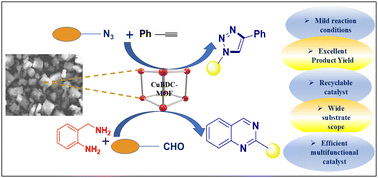
Even though metal–organic framework (MOF) materials are developing quickly, it is still very important to develop multifunctional MOFs with different sizes and morphological attributes and use them in catalytic applications. Cu based MOFs have garnered significant attention in the field of catalysis due to their high catalytic performance, cost effective synthesis and natural abundance of copper which make them easily accessible. Herein, we present an approach utilizing two Cu-based MOFs with distinct morphologies, synthesized via solvothermal (CuBDC-S) and reflux methods (CuBDC-O), as heterogeneous catalysts for the efficient synthesis of 1,4-disubstituted 1,2,3-triazoles (up to 98% yield) and 2-substituted quinazolines (up to 99% yield). The two different synthesis methods allowed us to modulate the morphology of the CuBDC (BDC-terephthalic acid) MOFs, thereby providing a unique opportunity to investigate the impact of structural differences on catalytic performance. Our results demonstrate that these MOFs, with their tailored morphologies, can significantly enhance catalytic activity under efficient conditions, offering good to excellent yields across a broad substrate range. CuBDC with a cubical morphology (CuBDC-O) synthesized by the reflux method exhibited higher efficiency in both catalytic reactions. Furthermore, to investigate the effects of morphology and other reaction parameters, two additional CuBDC MOFs were synthesised under modified conditions, one including a PVP assisted route (CuBDC-P) and another by an extended 24 h synthesis (CuBDC-M) while keeping the other parameters same as those of CuBDC-O. However, our findings reveal that none of the prepared catalysts could offer better yields as compared to CuBDC-O. This work represents the first report of utilizing morphology-controlled CuBDC MOFs for these two reactions, establishing a versatile and recyclable catalytic system. Our findings demonstrate the morphology transition in MOFs as a strategic tool for advancing heterogeneous catalysis in the synthesis of biologically important heterocycles.
- This article is part of the themed collections: Celebrating International Women’s Day 2026: Women in Inorganic Chemistry and Articles behind our 2025 journal covers
 Please wait while we load your content...


