


 PLATFORM UPDATE:


Spin-crossover semiconductors based on homoleptic tris-diimine Fe(ii) complexes with fractionally charged TCNQ˙δ− anions
 *ad
*ad
Abstract
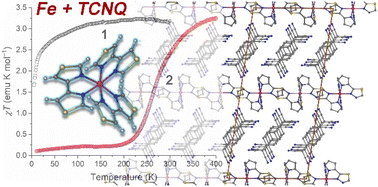
Two hybrid inorganic–organic materials were obtained by crystallization of metal cationic complexes [FeL3]2+ with fractionally charged organic radical anions TCNQ˙δ−, where L = 3-(thiazol-2-yl)pyrazole (3tpH) or 4,4′-bithiazole (4bt) and TCNQ = 7,7,8,8-tetracyanoquinodimethane. Crystal structure determination revealed the formula [FeL3](TCNQ)3 for each complex, indicating the average charge of −2/3 per each TCNQ unit. The crystal packing of each complex features layers of the [FeL3]2+ cations alternating with layers of 1D stacks of the TCNQ˙δ− anions. Magnetic measurements revealed a predominantly high-spin state of the Fe(II) ion for [Fe(3tpH)3](TCNQ)3 and a gradual spin crossover for [Fe(4bt)3](TCNQ)3. Transport measurements showed that both materials behave as semiconductors, with room-temperature conductivity values equal to 2.0 × 10⁻³ S cm−1 and 2.0 × 10⁻² S cm−1, respectively. The substantially higher conductivity of the bt-containing material was traced to the more uniform charge distribution over the TCNQ units, as established by the crystal structure analysis. Overall, this study provides insight into design principles for solvent-free crystal structures that combine spin crossover with electrical conductivity.
- This article is part of the themed collection: Dalton Transactions HOT Articles
 Please wait while we load your content...


