


 PLATFORM UPDATE:


Synthesis and SHG properties of the melamine-based material (C3N6H7)ZnX3(C3N6H6) (X = Cl, Br)
 a
Catharina Darine
Brand,
a
Patrick
Schmidt,
a
Dai
Zhang,
b
Carl P.
Romao
c
and
Hans-Jürgen
Meyer
*a
a
Catharina Darine
Brand,
a
Patrick
Schmidt,
a
Dai
Zhang,
b
Carl P.
Romao
c
and
Hans-Jürgen
Meyer
*a
Abstract
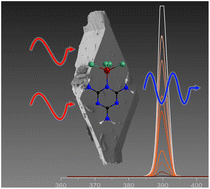
The zinc halide–melamine system was investigated by conducting exploratory solid-state reactions and hydrothermal syntheses, yielding Zn3(OH)2Cl4(C3N6H6)3 and (C3N6H7)ZnX3(C3N6H6) with X = Cl and Br. All compounds were characterized by single-crystal X-ray diffraction, revealing that there are two modifications of the melaminium–zinc-chloride–melamine compound, crystallizing with non-centrosymmetric space groups (Pna21 and P21). The presence of delocalized π-electron systems in compounds containing cyclic (B3O6)3−, (C3N3O3)3−, or melamine derivatives is known to give rise to significant second harmonic generation (SHG) properties, provided that the given structure has no inversion center. All crystal structures feature Zn2+ in a tetrahedral coordination environment, forming layered structures. Spectroscopic measurements on phase-pure orthorhombic (C3N6H7)ZnBr3(C3N6H6) resulted in direct and indirect band gaps of 4.74 eV and 4.46 eV respectively. Measurements of the nonlinear optical response performed on single crystals of three different compounds revealed significant intensities following the sequence monoclinic (C3N6H7)ZnCl3(C3N6H6) > orthorhombic (C3N6H7)ZnBr3(C3N6H6) > orthorhombic (C3N6H7)ZnCl3(C3N6H6). Their SHG properties are compared with those of KTP, one of the most widely used SHG materials.
- This article is part of the themed collection: Celebrating International Women’s Day 2026: Women in Inorganic Chemistry
 Please wait while we load your content...


