


 PLATFORM UPDATE:


Research progress in fluorescence sensors for the detection of Fe3+, Cr2O72− and nitrobenzene based on MOFs
Duo-Zhi
Wang  *a
*a
*a
Abstract
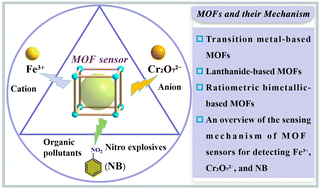
The accelerated progress of industrialization has led to anthropogenic and industrial activities that generate ferric ions (Fe3+), dichromate ions (Cr2O72−), and nitrobenzene (NB), causing severe environmental pollution and health hazards. Metal–organic frameworks (MOFs) exhibit wide-ranging sensing performance due to their structural diversity, designability, high specific surface area, porosity, and excellent fluorescence properties. In this perspective, we summarize the representative work to date in the field of sensing Fe3+, Cr2O72−, and NB using transition metal-based, lanthanide-based, and ratiometric bimetallic-based MOFs. Furthermore, the mechanism, current challenges, and prospects of MOF sensors have been elaborated upon.
- This article is part of the themed collection: 2025 Frontier and Perspective articles
 Please wait while we load your content...


