


 PLATFORM UPDATE:


Synthesis, coordination, and catalytic application of phosphinoferrocene ligands bearing flexible thienyl and thiazolyl pendants

Abstract
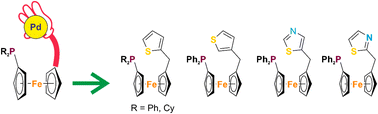
Modification of the ligand backbone by introducing spacer groups alters the coordination and catalytic properties of phosphine donors. This contribution describes the synthesis of five hybrid phosphinoferrocene ligands bearing heterocyclic pendant substituents, R2PfcCH2X, where R/X = Ph/2-thienyl (1), Cy/2-thienyl (2), Ph/3-thienyl (3), Ph/5-thiazolyl (4), and Ph/2-thiazolyl (5; fc = ferrocene-1,1′-diyl, Cy = cyclohexyl). The coordination properties of these flexible donors were examined in Pd(II) complexes. At a 1 : 2 Pd-to-ligand ratio, the reactions with a PdCl2 source uniformly gave bis(phosphine) complexes [PdCl2(L-κP)2] (L = 1–5). Upon reducing the ligand amount to 1 molar equiv., similar reactions afforded dimers [PdCl(μ-Cl)(L-κP)]2 for 1–3, the ligand-bridged dimer [(μ(P,N)-4)PdCl2]2, and the chelate complex [PdCl2(5-κ2P,N)]. The latter compound was evaluated in the Suzuki–Miyaura-type cross-coupling of aroyl chlorides with arylboronic acids, where it outperformed the benchmark catalyst [PdCl2(dppf-κ2P,P′)]. The reaction was further used to prepare 3-(trifluoromethyl)benzophenone, which was converted to the drug flumecinol.
 Please wait while we load your content...


