


 PLATFORM UPDATE:


Nanostructures based on gold and silica as a delivery platform for enhanced l-DOPA therapy in neurodegenerative disease
 *a
Elżbieta
Adamska,
a
Katarzyna
Zima,
b
Paulina
Nowicka,
a
Anna
Wcisło,
a
Mariusz
Makowski
a
and
Beata
Grobelna
*a
*a
Elżbieta
Adamska,
a
Katarzyna
Zima,
b
Paulina
Nowicka,
a
Anna
Wcisło,
a
Mariusz
Makowski
a
and
Beata
Grobelna
*a
Abstract
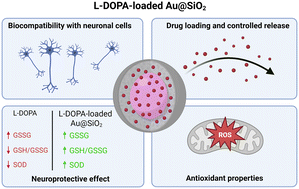
Neurodegenerative diseases, particularly Parkinson's disease (PD), remain a major clinical challenge due to the limited efficacy and side effects of current therapies. L-DOPA, the gold-standard drug for PD, suffers from low stability, poor bioavailability, and neurotoxicity upon prolonged use. To address these limitations, we report the design, synthesis, and evaluation of a silica-coated gold core–shell nanosystem (Au@SiO2) as a nanocarrier for the controlled delivery of L-DOPA. The nanostructures were synthesized via a bottom-up approach, stabilized with polyvinylpyrrolidone (PVP), and thoroughly characterized using TEM, UV-Vis, DLS, ELS, contact angle measurements, and electrochemical techniques. Despite modest L-DOPA loading efficiency (∼3%), the system demonstrated controlled and sustained drug release, with a marked difference between PVP-modified and unmodified systems. The nanocarrier exhibited high colloidal stability, hydrophilicity, and redox-protective effects over time, mitigating oxidative stress induced by L-DOPA, as well as minimal interaction with DNA. In vitro studies on SH-SY5Y cells confirmed good biocompatibility and a potential protective effect against oxidative stress, as evidenced by GSH : GSSG ratios and SOD activity. This multifunctional nanosystem offers a promising platform for brain-targeted drug delivery, combining biocompatibility, sustained release, and antioxidant-like activity reflected in the modulation of cellular redox balance (GSH/GSSG, SOD) – key advantages for next-generation neurotherapies.
 Please wait while we load your content...


