


 PLATFORM UPDATE:


Stability, structure, dynamics and thermal properties of C-type aluminium tris-dihydrogen phosphate

Abstract
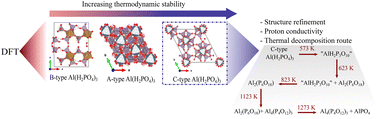
Among the fastest hydrogen ion conductors are various hydrogen-rich phosphates, such as phosphoric acid and CsH2PO4. This, in principle, makes Al(H2PO4)3 a promising candidate for proton conduction within its hydrogen bonding network, especially in the medium-temperature range. Here, the phase-pure synthesis and structural details of the ferroelectric crystal C-type Al(H2PO4)3 are reported, where density functional theory (DFT) calculations were used to study the thermodynamic stability of different Al(H2PO4)3 polymorphs. Its ion conductivity, as determined by impedance spectroscopy, is an order of magnitude higher than previously reported. The thermal stability and decomposition route of Al(H2PO4)3 were studied using XRD, thermal analysis, and solid-state NMR, yielding results different from those previously observed in various mixtures containing Al(H2PO4)3. Heating produces an amorphous intermediate phase which converts into phase-pure monoclinic Al2(P6O18), which at even higher temperatures converts into the cubic phase Al4(P4O12)3 and little AlPO4. Rietveld refinements of C-type Al(H2PO4)3 and Al4(P4O12)3 are provided. The results show that while the proton ion conductivity of C-type Al(H2PO4)3 is hampered by the strong hydrogen-bonds, the structure features a Curie temperature significantly higher than room-temperature.
- This article is part of the themed collection: Dalton Transactions HOT Articles
 Please wait while we load your content...


