


 PLATFORM UPDATE:


CO-free selective hydrogenation of CO2 to value-added formate under low-temperature aqueous conditions using a heterogenized Ru-PNP catalyst

Abstract
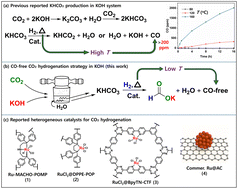
Considering that potassium hydroxide (KOH) is well known for its strong carbon dioxide (CO2) capture capability, a comparative study was conducted on low-temperature heterogeneous hydrogenation catalysts operable under CO2/hydrogen (H2)/KOH conditions. A series of Ru-based heterogeneous catalysts, supported on commercial activated carbon or coordinated with NN, PP, and PNP ligands were tested under identical conditions. Among them, the PNP ligand-based catalyst, Ru-MACHO-POMP (porous organometallic polymer), exhibited the highest activity, selectively producing potassium formate (HCO2K) with 100% yield even at 80 °C. Notably, no bicarbonate or carbon monoxide (CO) was detected after the reaction, indicating complete CO-free conversion. The catalyst maintained its activity with the porosity retained after multiple cycles, with no detectable Ru leaching. This study experimentally demonstrates the feasibility of a catalyst system capable of delivering high selectivity and stable performance under low-temperature conditions, providing a foundation for further catalyst development in KOH-based hydrogenation systems.
 Please wait while we load your content...


