


 PLATFORM UPDATE:

A high-capacity and stable rate-performance Li-ion battery anode based on hierarchical microcakes with in situ grown nanoflakes
 *de
and
Jinyun
Liu
*b
*de
and
Jinyun
Liu
*b
Abstract
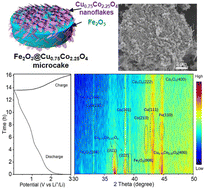
Designing high-performance anode materials is highly required and significant for developing next-generation Li-ion batteries since currently available graphite-based anodes can hardly meet the requirements of advanced battery systems. Here, we develop an Fe2O3 microcake grown with Cu0.75Co2.25O4 nanoflakes, forming a hierarchically micro-nanostructured Fe2O3@Cu0.75Co2.25O4 composite, which exhibits high electrothermal performance as a Li-ion battery anode material. The hierarchical structure effectively prevents the deterioration of cycling performance caused by large volume change during cycling, while the nanoflakes grown on microcakes facilitate transport of ions and electrons. The results show that the Fe2O3@Cu0.75Co2.25O4 microcake-based anode exhibits a high and stable capacity of 1029 mAh g−1 after 100 cycles at 0.2 A g−1, and stable rate performance is also achievable. Moreover, an in situ X-ray diffraction study indicates reversible phase conversion upon charge–discharge. Our findings provide a promising design of a hierarchical microcake structure for developing high-performance energy-storage composites and their secondary batteries.
 Please wait while we load your content...


