Issue 48, 2025

Syntheses, crystal structures, and proton conduction properties of two zirconium fluorophosphonates

Abstract

By introducing hydrogen fluoride (HF) and a competitive ligand into the synthetic system to enhance the crystallinity of products, two two-dimensional (2D) zirconium fluorophosphonate compounds with high crystallinity, namely A2[Zr(hedp)F2] (hedpH2 = 1-hydroxyethylidene-1,1-diphosphonic acid, A+ = K+ (1), NH4+ (2)), were successfully prepared. Their structures feature the anionic layer of [Zr(hedp)F2]n2n− with A+ cations located in interlayer spaces. The unique coexistence of F, –OH, and –PO3 moieties within the structure generates an extensive hydrogen-bonding network, facilitating efficient proton transport. At the temperature of 85 °C and the relative humidity (RH) of 95%, the proton conductivity (σ) of compounds 1 and 2 is 6.37 × 10⁻⁴ S cm−1 and 1.27 × 10⁻² S cm−1, respectively. The proton conductivities of both compounds follow the Grotthuss mechanism. Compound 2 demonstrates better proton conductivity owing to the presence of NH4+ cations, which facilitate the formation of extensive hydrogen-bonding networks that enable efficient proton transport. This study endows the zirconium fluorophosphate family with new members and provides a feasible research strategy for constructing highly crystalline metal fluorophosphonate compounds.
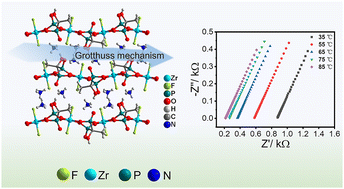
Graphical abstract: Syntheses, crystal structures, and proton conduction properties of two zirconium fluorophosphonates

Supplementary files

Article information

Article type
Paper
Submitted
01 Aug 2025
Accepted
03 Nov 2025
First published
07 Nov 2025
This article is Open Access
Creative Commons BY-NC license

Dalton Trans., 2025,54, 17991-17997

Syntheses, crystal structures, and proton conduction properties of two zirconium fluorophosphonates

S. Liu, Y. Zhao, Y. Ren, Z. Chen, L. Yang, Z. Chen, Z. Wei, H. Sun, M. Feng and X. Huang, Dalton Trans., 2025, 54, 17991 DOI: 10.1039/D5DT01846C

This article is licensed under a Creative Commons Attribution-NonCommercial 3.0 Unported Licence. You can use material from this article in other publications, without requesting further permission from the RSC, provided that the correct acknowledgement is given and it is not used for commercial purposes.

To request permission to reproduce material from this article in a commercial publication, please go to the Copyright Clearance Center request page.

If you are an author contributing to an RSC publication, you do not need to request permission provided correct acknowledgement is given.

If you are the author of this article, you do not need to request permission to reproduce figures and diagrams provided correct acknowledgement is given. If you want to reproduce the whole article in a third-party commercial publication (excluding your thesis/dissertation for which permission is not required) please go to the Copyright Clearance Center request page.

Read more about how to correctly acknowledge RSC content.

Social activity

Spotlight

Advertisements