


 PLATFORM UPDATE:


Controlled synthesis and multi-effect synergistic lithium storage of micron-sized porous hexagonal prismatic titanium-based high-entropy oxide anodes
 *a
Zhen-Dong
Huang
*a
*a
Zhen-Dong
Huang
*a
Abstract
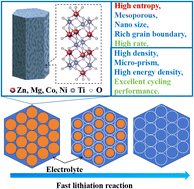
Metal–organic frameworks (MOFs) have emerged as promising precursors or alternative anode materials for lithium-ion batteries (LIBs). In this work, a Ti-based MOF (Zn0.18Mg0.2Co0.31Ni0.37-Ti-EG (ethylene glycol)) was controllably synthesized through a controllable approach integrating solution self-assembly with hydrothermal techniques. Subsequently, Zn0.18Mg0.2Co0.31Ni0.37-Ti-EG hexagonal prisms were applied as precursors to produce grain-boundary-rich porous hexagonal prismatic Zn0.18Mg0.2Co0.31Ni0.37TiO3via sintering under optimized temperature and air conditions. Zn0.18Mg0.2Co0.31Ni0.37TiO3 possesses a high compacted density of 2.234 g cm−3. Benefitting from the synergistic effect of a high entropy, porous, and grain-boundary-rich structure, the newly developed Zn0.18Mg0.2Co0.31Ni0.37TiO3 exhibits desirable electrochemical performance. It demonstrates impressive cycling stability, maintaining 484.03 mAh g−1 after 100 cycles at 0.2 A g−1. Moreover, it has a coulombic efficiency of 99.83% after 1000 cycles at a high current density of 2 A g−1. This study provides a novel perspective and methodology for developing high-entropy MOF-derived anode materials for energy storage.
 Please wait while we load your content...


