


 PLATFORM UPDATE:


Zn-cycloalkyldicarboxylate 2D-coordination polymers bearing 4,4′-trimethylenebipyridine: crystal structures, solid state CPMAS 13C NMR structural correlations and luminescence sensing of ethanol
 *a
Luis D.
Rosales-Vázquez,
bc
Juan M.
German-Acacio,
d
Cristian
Pinzón-Vanegas,
c
Alejandro
Dorazco-González
*c
*a
Luis D.
Rosales-Vázquez,
bc
Juan M.
German-Acacio,
d
Cristian
Pinzón-Vanegas,
c
Alejandro
Dorazco-González
*c
Abstract
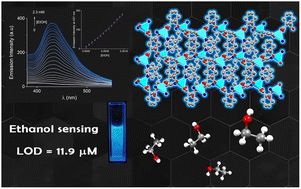
Self-assembly reactions of Zn(II) with cyclobutane-1,1′-dicarboxylate (cbdc) or cyclohexane-1,1′-dicarboxylate (chdc) and 4,4′-trimethylenebipyridine (tmbp) generated three flexible mixed-ligand coordination polymers: {[Zn(cbdc)(tmbp)]·(H2O)}, 1; {[Zn(H2O)(cbdc)(tmbp)]}, 2; and {[Zn(chdc)(tmbp)]·H2O}, 3. These crystalline polymers were characterized by elemental analyses, FT-IR, single-crystal X-ray diffraction, Hirshfeld surfaces, and cross polarization-magic angle spinning (CPMAS) 13C NMR, featuring two-dimensional (2D) coordination arrays, with different topologies. The CPMAS 13C solid-state NMR spectra of 1–3 depict the symmetry-independent aromatic and aliphatic carbon atoms and the tmbp/cbdc-to-chdc ligand ratio in agreement with the asymmetric unit from crystal structures. The solid-state luminescence properties of 1–3 were investigated; 1 and 3 exhibited strong blue emissions at 440 nm and 436 nm, respectively, upon excitation at 330 nm, compared to 2. Structure-related photoluminescence is attributed to the effective bidentate coordination mode of the fluorescent ligand tmbp in 1 and 3. In particular, polymer 3 is photostable in ethanolic solution in the micromolar concentration range with emission at 431 nm, a quantum yield of Φ = 0.11 and bi-exponential lifetimes of τ1 = 5.02 ns and τ2 = 1.13 ns. Furthermore, Zn(II)-polymer 3, suspended in water, allows the fluorescence selective sensing of ethanol over common organic solvents such as alcohols, DMF, DMSO, THF and CH3CN, based on a turn-on fluorescence intensity with a limit of detection 11.9 ± 0.2 μM. The use of flexible Zn(II)-coordination polymers as fluorescent sensors for fast and selective detection of ethanol in aqueous settings has been unexplored until now.
 Please wait while we load your content...


