


 PLATFORM UPDATE:

Synthesis and optical properties of a LiCaY(MoO4)3:Eu3+ red phosphor with negligible concentration quenching for highly efficient white LED and plant growth applications

Abstract
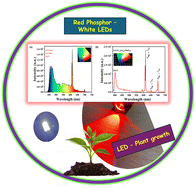
The development of white LED applications employing oxide-based phosphors faces difficulties in finding highly efficient narrow-band-based red-emitters. One possible solution is to use trivalent europium ion-based phosphors; however, their weak oscillator strength limits their suitability for white LED applications. In the present investigation, LiCaY(1−x)Eux(MoO4)3 was developed as an efficient narrow-band red phosphors for white LED applications. The traditional solid-state reaction was used to synthesize a series of LiCaY(1−x)Eux(MoO4)3 phosphors, where x = 0.1–1. The crystal structure was analyzed using powder X-ray diffraction (PXRD). The 5D0 → 7F2 electric dipole transition of the Eu3+ ion was responsible for sharp emission at 616 nm under 395 nm excitation for all the phosphors. The concentration-dependent photoluminescence (PL) study showed nearly zero concentration quenching in the systems, making them more efficient than commercial red phosphors. The phosphor exhibited an excellent thermal stability of 88.53% at 150 °C, calculated with respect to room temperature emission intensity. Along with the europium-doped red phosphor, samarium-activated and Eu–Sm co-doped phosphors were synthesized and studied. A white LED was fabricated using LiCaY0.2Eu0.8(MoO4)3, and a CRI value of 72 was obtained, with a CCT of 7986 K and CIE coordinates of (0.29, 0.30). A deep orange-red LED was fabricated using the red phosphor and a near-UV LED to cover the phytochrome spectra for plant growth application.
 Please wait while we load your content...


