


 PLATFORM UPDATE:


Higher order structures in chemistry: hypergraphs reshape the molecule and the reaction†

Abstract
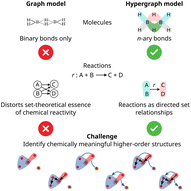
Chemical systems contain higher-order relationships that exceed the binary constraints of traditional graph-based models. Although graph theory has long supported the digital representation of molecules and reactions, many fundamental chemical phenomena—such as multi-centre bonding, aromaticity, cooperative interactions, and the inherently set-theoretical nature of reactions—escape pairwise encodings. This work introduces hypergraphs and an extended “zoo” of higher-order mathematical structures as a unified framework for modelling both molecular structures and reaction networks. Molecular hypergraphs naturally capture multi-atomic interactions, while directed hypergraphs offer a mathematically faithful representation of reactions as transformations between arbitrary sets of substances. More sophisticated variants—including ordered, directed, binary, and directed-ordered hypergraphs—enable the incorporation of additional chemical information, such as atomic ordering, ligand–pocket affinities, and cavity organisation in porous materials at the substance level, as well as toxicity and economic constraints at the reaction level. Recent advances in hypergraph spectral theory, random models, and higher-order network statistics have opened new chemical, mathematical, and computational avenues. These developments coincide with emerging machine-learning evidence showing that hypergraph-based representations of molecules can outperform graph-based and even 3D-coordinate models. By outlining both the capabilities and current limitations of hypergraph approaches, this work argues that higher-order mathematical structures will be central to the next generation of digital discovery, enabling more faithful representations of chemical complexity and deeper integration across chemistry, mathematics, and computer science.
 Please wait while we load your content...


