


 PLATFORM UPDATE:


Can we automate scientific reasoning in closed-loop experiments using large language models?
 a
Andrew I.
Cooper
*a
a
Andrew I.
Cooper
*a
Abstract
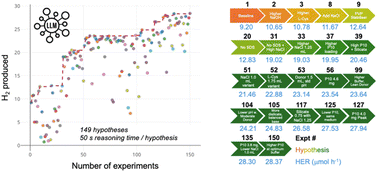
We present here a detailed study of our hybrid optimisation framework, BORA, which integrates large language model (LLM) reasoning with Bayesian optimisation (BO) for accelerating scientific discovery using closed-loop experiments. We compare five reasoning models (o4-mini, o3, gpt-5-mini, gpt-5, and gemini-2.5-flash) as optimisers for two benchmark problems: a 10-dimensional photocatalytic hydrogen-evolution experiment and a 7-dimensional physics-based pétanque simulation. The results show that LLM/BO hybrids outperform BO-only approaches, particularly in early-stage exploration where the search is warm-started by LLM-driven hypotheses. Among the models tested, o3 delivered the strongest and most consistent optimisation performance after 150 experiments. LLM-only optimisations without the BO component also matched or surpassed hybrid methods in some settings, locating optima with high repeatability. We demonstrate that appending human hypotheses, prior literature, or experimental datasets can improve convergence, and that LLM reasoning can recover in some cases from deliberately misleading prompts. We also explore outlier runs to understand the limitations and failure modes of these methods, as well as considering the energy implications of the LLM queries. The strongest LLM-only performance was observed with a batch size of one, suggesting that experiment-by-experiment machine reasoning is a viable strategy for certain automated scientific optimisation tasks.
 Please wait while we load your content...


