


 PLATFORM UPDATE:


Design of simple-structured conjugated polymers for organic solar cells by machine learning-assisted structural modification and experimental validation
 *ab
*ab
Abstract
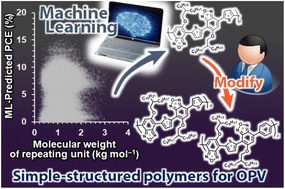
Improving the performance of organic photovoltaics (OPVs) depends on the development of new p-type polymers and n-type non-fullerene acceptor (NFA) molecules. However, conventional experimental and theoretical methods are inefficient for exploring the vast chemical space. In this report, we use machine learning (ML) to explore simple-structured p-type polymers. The structural simplicity is associated with a small synthesis step relevant for low-cost, large-scale production. By considering the structural simplicity (primitively based on the molecular weight of its repeating unit) of the 200 thousand virtually generated polymers, together with synthetic accessibility, we focus on copolymers composed of benzoxadiazole as an acceptor and thiophene (or phenylene) as a donor. Although the structures of these copolymers resemble a high-performance simple-structured PTQ10, their structural symmetries (regioregularity) are modified for synthetic reasons. Through the characterization of the synthesized polymers, their OPV devices blended with Y6 NFA, and resultant synthetic complexity scores, we show that our polymer with a minor manual modification of the donor and alkyl chain exhibits a power conversion efficiency of 5.56%, which closely aligns with that predicted by ML and provides a basis for the further development of novel polymers with low synthesis and search costs.
 Please wait while we load your content...


