


 PLATFORM UPDATE:

Kinetic predictions for SN2 reactions using the BERT architecture: comparison and interpretation
 †*a
María
Calvo,
a
Stamatia
Zavitsanou,
a
James D.
Somper,
a
Ewa
Wieczorek,
a
Tom
Watts,
a
Jason
Crain
b
and
Fernanda
Duarte
*a
†*a
María
Calvo,
a
Stamatia
Zavitsanou,
a
James D.
Somper,
a
Ewa
Wieczorek,
a
Tom
Watts,
a
Jason
Crain
b
and
Fernanda
Duarte
*a
Abstract
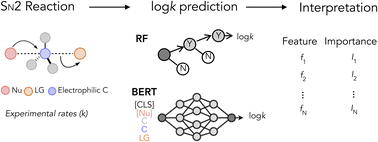
The accurate prediction of reaction rates is an integral step in elucidating reaction mechanisms and designing synthetic pathways. Traditionally, kinetic parameters have been derived from activation energies obtained from quantum mechanical (QM) methods and, more recently, machine learning (ML) approaches. Among ML methods, Bidirectional Encoder Representations from Transformers (BERT), a type of transformer-based model, is the state-of-the-art method for both reaction classification and yield prediction. Despite its success, it has yet to be applied to kinetic prediction. In this work, we developed a BERT model to predict experimental log k values of bimolecular nucleophilic substitution (SN2) reactions and compared its performance to the top-performing Random Forest (RF) literature model in terms of accuracy, training time, and interpretability. Both BERT and RF models exhibit near-experimental accuracy (RMSE ≈ 1.1 log k) on similarity-split test data. Interpretation of the predictions from both models reveals that they successfully identify key reaction centres and reproduce known electronic and steric trends. This analysis also highlights the distinct limitations of each; RF outperformed BERT in identifying aromatic allylic effects, while BERT showed stronger extrapolation capabilities.
 Please wait while we load your content...


