


 PLATFORM UPDATE:


Ambient condition imine formation from the homocoupling of benzylamine using copper catalysis and dialkylphosphite as a substoichiometric additive

Abstract
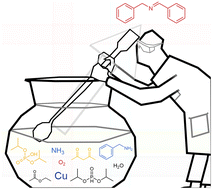
The oxidative homocoupling of benzylamines to form imines is an attractive approach for the preparation of symmetric imines, thereby reducing the need for an aldehyde coupling partner. However, most oxidative couplings require harsh conditions, strong oxidants, or lead to significant by-product generation, such as the formation of nitriles or aldehydes. Herein, we report the serendipitous discovery of a selective approach for the oxidative homocoupling of benzylamine using copper catalysis with a substoichiometric dialkylphosphite additive. A mechanistic proposal for imine formation requiring this unusual additive is developed based on investigations into the relationship between reaction conditions and reaction outcomes. These conditions include the presence of phosphite and other additives, atmospheric air, copper catalysts, and the relative concentration of components, accompanied by spectroscopic investigation of the reaction mixture. As this method proceeds under ambient conditions, using atmospheric air as the oxidant and without the need of drying agents or other additives, these outcomes will aid the development of more sustainable processes for imine preparation.
 Please wait while we load your content...


