


 PLATFORM UPDATE:


Importance of metal intimacy in tuning CO2 hydrogenation selectivity over Cu-exchanged TiO2 supported Rh catalysts via enhanced CO intermediate interaction

Abstract
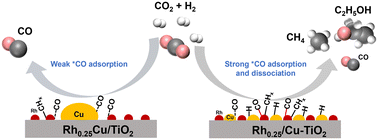
It is crucial to regulate the metal intimacy in bimetallic catalysts for tuning the product selectivity in CO2 hydrogenation. In this study, we developed a Rh/Cu–TiO2 catalyst using a Cu ion-exchange strategy to construct the Cu–TiO2 support with highly dispersed Cu species, thereby enhancing the intimacy between Rh and Cu. HRTEM confirmed that the ion-exchange method achieved exceptional Cu dispersion (2.67 ± 0.83 nm nanoparticles) and improved the intimacy between Rh and Cu species. The catalytic CO2 hydrogenation performance of the Rh/Cu–TiO2 catalyst was systematically examined and compared with a conventional co-impregnated RhCu/TiO2 catalyst. Interestingly, activity evaluation results demonstrated that the improved Rh–Cu intimacy in the Rh/Cu–TiO2 catalyst can promote the adsorption of *CO intermediates as well as their further hydrogenation into CH4 or coupling with CHx species to produce ethanol. Accordingly, Rh0.25/Cu–TiO2 exhibited the best ethanol STY (558.4 mgethanol gRh−1 h−1), representing a 1.9-fold enhancement versus the co-impregnated RhCu/TiO2 catalyst (284.4 mgethanol gRh−1 h−1). Through comprehensive characterization techniques, including H2-TPR, CO-TPD, XPS, CO-DRIFTS, and in situ DRIFTS, we demonstrate that the enhanced Rh–Cu intimacy and its effective regulation of the surface electronic structure can (i) strengthen the adsorption and dissociation capacity of *CO on Rh0 sites as well as the hydrogenation activity on Cu0 sites, (ii) promote the dissociative hydrogenation of partial *CO species to form *CHx intermediates, and (iii) thereby facilitate both methane formation and efficient C–C coupling between *CHx and adjacent *CO species to produce ethanol. Our findings underscore that regulating the intimacy of active sites is essential for designing highly efficient catalysts to modulate product selectivity in CO2 hydrogenation, particularly toward ethanol synthesis.
- This article is part of the themed collection: Catalysis Science & Technology Pioneering Investigators
 Please wait while we load your content...


