


 PLATFORM UPDATE:


Influence of coprecipitation on structural evolution of Cu–Zr catalysts
 *ab
*ab
Abstract
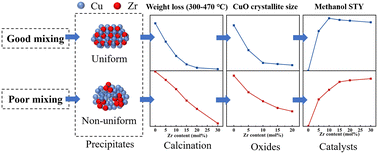
The interaction between Cu and Zr is crucial for the performance of Cu-based catalysts in CO2 hydrogenation. This study compares a series of Cu–Zr catalysts with different Cu–Zr ratios prepared at two flow rates in a microreactor. The structural evolution of the catalysts was investigated using X-ray diffraction (XRD), thermogravimetric analysis (TGA), transmission electron microscopy (TEM), X-ray photoelectron spectroscopy (XPS), and temperature-programmed desorption (CO2-TPD). It is found that the enhanced mixing in the microreactor improves component dispersion in the Cu–Zr precipitates, leading to smaller CuO crystallite sizes in the calcined oxides and more Cu–Zr interfaces in the reduced catalysts, which thereby exhibit superior catalytic performance. Additionally, superior mixing in the coprecipitation enables the catalyst to achieve abundant Cu–Zr interfaces even at lower Zr content, whereas catalysts prepared under inferior mixing require higher Zr content to establish adequate Cu–Zr interfaces.
 Please wait while we load your content...


