


 PLATFORM UPDATE:


Role of long-chain carboxylate ligands in glycerol dehydrogenation catalyzed by Co decorated nanoparticles†
 a
Carine
Michel
*b
a
Carine
Michel
*b
Abstract
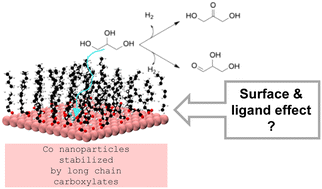
Acceptorless dehydrogenation of alcohols is a green process to obtain several added-value products such aldehydes and ketones and H2. Decorated Co nanoparticles have shown great catalytic activity in this reaction. In this catalytic system, long-chain carboxylate ligands are present to protect the Co nanoparticles from aggregation and oxidation and to stabilize their shape. The most active shape is as a nanorod, exposing mainly the Co(0001) and Co(11−20) surfaces. We propose here the combination of classical molecular dynamics and DFT to better understand the role of carboxylate ligands when decorated Co nanorods are used as catalysts in glycerol dehydrogenation. Classical molecular dynamics simulations provided the free energy of adsorption at the interface as a function of the ligand surface coverage on the two mainly exposed facets Co(0001) and Co(11−20). This allows us to determine the possible organization of carboxylate ligands around the active site using DFT to investigate the activity and selectivity of glycerol dehydrogenation into dihydroxyacetone (DHA) or glyceraldehyde (GLYA) on the two exposed facets. We found that DHA, which is the thermodynamic product, is predicted to be the dominant product. Pristine Co(11−20) and decorated Co(0001) are the most active surfaces, showing that the presence of ligands can alter the structure sensitivity of a reaction, an effect that needs to be taken into account in the design of shaped decorated metallic nanoparticles to be used as catalysts.
 Please wait while we load your content...


