


 PLATFORM UPDATE:


Gas-phase negative ion photoelectron spectroscopy and reactivity of phenylacetylide PhCC−

Abstract
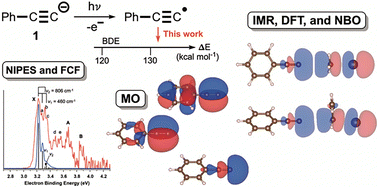
Arylacetylides such as phenylacetylide (PhCC−, 1) are important nucleophiles used in synthetic chemistry yet they have rarely been studied as bare carbanions. In this work, the phenylacetylide anion was formed via electrospray ionization (ESI) or multistage mass spectrometry (MSn) experiments and subsequently examined in the gas phase by negative ion photoelectron spectroscopy (NIPES) and ion–molecule reactions (IMR), alongside theoretical calculations to probe its fundamental structure and reactivity. Photoelectron spectra of PhCC− (1) revealed vertical (VDE) and adiabatic detachment energies (ADE), both being 3.220 eV. The latter value is also the electron affinity (EA) of the phenylethynyl radical (PhCC˙) from which a bond dissociation energy (BDE) of 131.3 ± 2.5 kcal mol−1 of phenylacetylene (PhCCH) was derived using a gas-phase thermochemical cycle. Detachment of PhCC− at 266 nm likely involves photoexcitation to an excited electronic state of the anion from which resonant electron autodetachment occurs, supported by Franck–Condon factor (FCF) simulations. The phenylacetylide anion reacts with methyl iodide (CH3I) and allyl iodide (C3H5I) via SN2 nucleophilic displacement with measured rate coefficients of 4.29 and 3.66 × 10⁻¹⁰ cm3 molecule−1 s−1, respectively. The mechanisms associated with these displacement reactions are explained and understood in terms of the reaction kinetics, natural bond orbital (NBO) theory, and density functional theory (DFT) calculations.
 Please wait while we load your content...


