


 PLATFORM UPDATE:


Pressure-induced tunability and conductivity minimum in 3C-SiC for optoelectronic applications
 *a
and
*a
and
Abstract
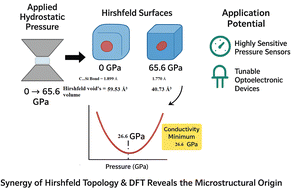
This study unveils the pressure-induced tuning of the optoelectronic properties of cubic silicon carbide (3C-SiC) through a novel synergic approach that combines Hirshfeld topological analysis (HTA) with first-principles calculations. Our simulations reveal a systematic compression of the crystal lattice, with the lattice parameter decreasing from 4.380 Å to 4.088 Å as pressure increases to 65.6 GPa. This structural evolution drives significant blueshifts in the complex dielectric function and reflectivity. The key finding is the discovery of a distinct minimum in the electrical conductivity at a critical pressure of 26.6 GPa. Crucially, HTA provides the microstructural rationale, correlating this minimum with the evolution of void spaces (e.g., Hirshfeld volume of ∼348.4 Å3, and void volume of 49.92 Å3). This phenomenon demonstrates the potential of 3C-SiC for designing highly sensitive pressure sensors and tunable optoelectronic devices that operate in extreme environments. This work establishes a framework for optimizing functional materials through targeted manipulation of their topological properties.
 Please wait while we load your content...


