


 PLATFORM UPDATE:


Quantifying the liquid–liquid transition in cold water/glycerol mixtures by intermolecular hyperfine relaxation-induced dipolar modulation enhancement (ih-RIDME)
 †*a
and
Maxim
Yulikov
*a
†*a
and
Maxim
Yulikov
*a
Abstract
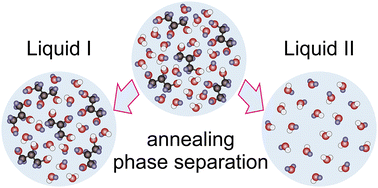
Water/glycerol mixtures are commonly used for experiments with biomacromolecules at cryogenic temperatures due to their vitrification properties. Above the glass transition temperature, they undergo liquid–liquid phase separation. Using a novel EPR technique called intermolecular hyperfine relaxation-induced dipolar modulation enhancement (ih-RIDME), we quantified the molar composition in frozen water/glycerol mixtures with one or the other component deuterated after the phase transition. Our experiments reveal a nearly equal phase composition regardless of the proton/deuterium isotope balance. With the new ih-RIDME data, we can also revisit the previously reported body of glass transition data for these mixtures and build a consistent picture of water/glycerol freezing and phase transitions. Our results also indicate that ih-RIDME has the potential to be used for investigating the solvation shells of spin-labelled macromolecules.
 Please wait while we load your content...


