


 PLATFORM UPDATE:


Optimization of vibrationally promoted electronic resonance (VIPER) excitation

Abstract
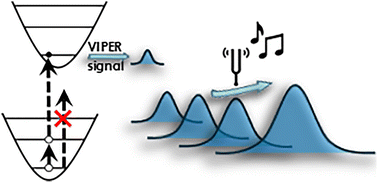
Vibrationally promoted electronic resonance 2D-infrared (VIPER 2D-IR) spectroscopy is a powerful spectroscopic method using a sequence of IR and UV/VIS ultrafast laser pulses, which can for instance be used for 2D-IR spectral diffusion measurements beyond the vibrational lifetime or to induce subensemble-selective light-triggered processes. Its successful application depends e.g. on the intensities of the pulsed laser beams, their exact wavelengths, pulse timings and polarizations as well as on sample-dependent parameters such as concentration and optical pathlength. In this work a systematic experimental and theoretical approach is taken to optimize different parameters of the detected signals. Notably, when going from low to high optical density in the UV/VIS range, the VIPER 2D-IR signal can transition from being proportional to being inversely proportional to the number of molecular absorbers present in the sample. A reversal in signal sign can be induced simply by tuning the UV/VIS pump wavelength. Exploring these and other experimental variables provides a detailed insight into the molecular parameters that govern the amplitude of the observed VIPER 2D-IR signal. This study aims to assist in the design of VIPER 2D-IR experiments that achieve the largest possible signal amplitudes as well as obtain optimal chemical contrast between different co-existing molecular species that can be excited and observed. It also provides important insight for other experimental techniques that are based on the modulation of the UV/VIS cross-section by IR excitation.
 Please wait while we load your content...


