


Towards full optimisation of automated double electron–electron resonance spectroscopy

Abstract
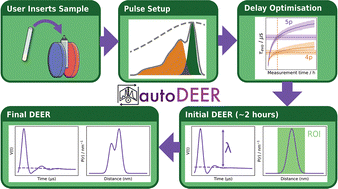
The double electron–electron resonance (DEER) experiment is widely applied for measuring distance distributions in biological systems and synthetic materials. Optimal manual setup requires substantial expertise and effort. In order to make DEER more accessible and to improve the reliability and reproducibility, we lay out a highly optimised and fully automatable protocol for nitroxide–nitroxide DEER spectroscopy, utilising the latest developments in pulse sequences and data processing. Additionally, we present autoDEER, a Python-based software that enables automatic DEER measurements on a wide range of spectrometers, both home-built and commercial. We show that autoDEER is able to perform a DEER measurement after sample insertion at the push of a button, including all the necessary setup experiments as well as inference of the distance distribution from the measured data. We apply this protocol to a range of samples of current interest in biology, illustrating that it is both robust and generally applicable.
 Please wait while we load your content...


