


 PLATFORM UPDATE:


Trifluoroacetic acid formation from HFC-134a under atmospheric conditions

Abstract
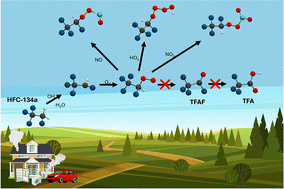
Trifluoracetic acid (CF3COOH, TFA) is touted as a primary degradation product from atmospheric oxidation of HFC-134a (CF3CH2F). TFA poses a significant environmental challenge, such as bioaccumulation due to its high stability in terrestrial conditions. While several global atmospheric modeling studies predict varied amount of TFA formed from HFC-134a, the potential energy profile of this process has not been established and many of the proposed reaction mechanisms remain at the level of pushing arrows. This theoretical study first outlines the potential energy profile of OH radical initiated oxidation of HFC-134a along with subsequent reactions that lead to the formation of TFA. Secondly, master equation simulations are performed to quantify the kinetics of each reaction step mimicking atmospheric conditions. Key findings from the potential energy profile reveal detailed mechanism involved in TFA formation along with other competing fluorinated products. However, both TFA and its precursor trifluoroacetyl fluoride (CF3CFO, TFAF) product forming channels have inaccessible energy barriers under atmospheric conditions. Although this research does not rule out the possibility that TFA can be formed from HFC-134a in the atmosphere, it casts doubt on the feasibility of the previous proposed mechanism.
 Please wait while we load your content...


