


 PLATFORM UPDATE:

On the origin of fragments observed in electron ionisation mass spectrometry of water clusters in superfluid helium nanodroplets

Abstract
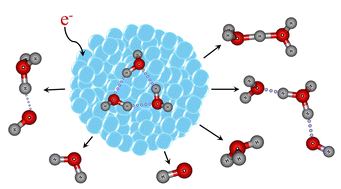
In this study, we formed water clusters inside superfluid helium nanodroplets and analysed them using electron ionisation mass spectrometry. The resulting mass spectrum has strong features, corresponding to H+(H2O)k−1 fragments, and multiple series of weaker features corresponding to (H2O)k˙+, H+Hen, OH+Hen, H2O˙+Hen and H3O+Hen fragments. To determine the origin of these features, we have performed a systematic and comprehensive analysis of the mass spectra recorded as a function of the partial pressure of water. This analysis allowed us to assign the origin of all the observed fragments that correspond to water clusters within helium nanodroplets. We show that the smaller water clusters, (H2O)k (k ≤ 4), can fragment into multiple mass channels. In contrast, the electron ionisation of larger water clusters, observed in this work, produces at most two mass channels: one corresponding to an intact cluster ion (H2O)k˙+ (observed up to k = 10) and another corresponding to its subsequent fragmentation into H+(H2O)k−1. The selective fragmentation of larger clusters into a single protonated cluster H+(H2O)k−1 is likely due to the presence of a stable eigen cation H3O+(H2O)3 core in these protonated fragments. We further show that the observed fragments with helium atoms attached originate from water clusters up to trimers with no detectable contributions from larger water clusters. We have also gained new insights into the formation of unprotonated water cations, (H2O)k˙+, showing that droplet size plays a crucial role in their stabilisation, with larger droplets favouring the formation of larger cations.
 Please wait while we load your content...


