


 PLATFORM UPDATE:


Modeling CH3SOH–aromatic complexes to probe cysteine sulfenic acid–aromatic interactions in proteins
 ab
and
Ann M.
English
*a
ab
and
Ann M.
English
*a
Abstract
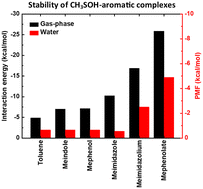
Cysteine sulfenic acid (CysOH), formed on oxidation of Cys residues, is an intermediate in the catalytic cycles of numerous antioxidant enzymes and participates in oxidative-stress sensing and redox signaling. Proteins control CysOH reactivity in part by its interactions with aromatic residues. To characterize such interactions, we performed extensive ab initio quantum mechanical calculations with MP2(full)/6-311++G(d,p) on complexes of CH3SOH as a CysOH model with side-chain models for Phe (toluene), Trp (3-methylindole), Tyr/Tyr− (4-methylphenol/4-methylphenolate) and His/HisH+ (4-methylimidazole/4-methylimidazolium) residues. The gas-phase global minima conformers extracted from the 67 aromatic complexes found exhibit binding energies of ∼−5 to −25 kcal mol−1. In the neutral CH3SOH–aromatics, the center oxidized is the stronger H-bond donor, which varies with the geometry of the complex as does the ionization potential (IPV). While CH3SOH (IPV = 9.20 eV) is exclusively oxidized when complexed to 4-methylimidazolium (IPV = 14.64 eV), the phenol ring is oxidized in all CH3SOH complexes with 4-methylphenolate (IPV = 3.31 eV). To perform molecular dynamics (MD) simulations of the aqueous complexes, a potential model was optimized for CH3SOH and calibrated for its interactions with the aromatic ions. The MD simulations reveal that in bulk water the S atom preferentially adopts en-face or intermediate binding geometry with binding free energies of ∼−0.6, −2.5 and −5 kcal mol−1 for the neutral, imidazolium and phenolate complexes, respectively. Overall, the gas-phase and aqueous CH3SOH complexes are 40–170% more stable and 0–40% less stable, respectively, than their CH3SH counterparts. Exceptionally, aqueous 4-methylphenolate binds CH3SOH ∼50% more tightly than CH3SH due to strong σ-type O–H⋯Oar H-bond bonding. Examination of a subset of CysOH–aromatics from the Protein Data Bank highlight their role in CysOH formation and stabilization in proteins.
- This article is part of the themed collection: Showcasing the Breadth of Physical Chemistry Chemical Physics Research in Canada
 Please wait while we load your content...


