


 PLATFORM UPDATE:

Tunable reducibility of alkaline earth metal clusters for carbon dioxide and nitrogen molecule activation: a QM-QSPR study

Abstract
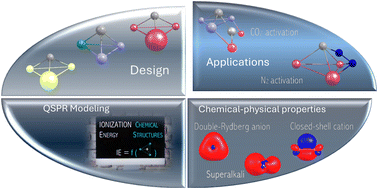
A hybrid approach combining ab initio computational techniques of quantum chemistry with a machine learning strategy was used to design and investigate BAe3 (Ae = Be, Mg, Ca, Sr, and Ba) molecular clusters with strong reducing abilities. In these systems, the type of electropositive alkaline earth metal atoms was varied to tune the physicochemical properties of the resulting BAe3 system. Both basic systems (built of three identical substituents, such as BSr3) and mixed systems (containing various substituents, such as BCaMg2) were considered. The BAe3 clusters feature low ionization energies (IEs) and a highly delocalized singly occupied molecular orbital (SOMO). Among them, the BBa3 cluster was identified as having the lowest IE here (3.82 eV), exhibiting the superalkali characteristic, which is smaller than that of any alkali [3.89 eV (cesium atom)]. The BAe3+ thermodynamically stable closed-shell cations were shown to accommodate two electrons into their Rydberg orbitals, forming the double-Rydberg anions with electron binding energies in the 0.434–1.988 eV range. A mathematical model describing the dependence of IEs of BAe3 clusters on their composition was developed. Different from the conventional formulation-assisted methodology, the quantitative structure–property relationship (QSPR) strategy predicts the reducing ability of a BAe3 superalkali, where a suitable alkaline earth metal decreases the IE of the resulting BAe3 cluster via the B–Ae and Ae–Ae electrostatic effects. Finally, the potential application of BAe3 electron donors in the reduction of counterpart systems with low electron affinity (such as carbon dioxide or nitrogen molecules) was demonstrated. From the analysis of the binding energy between BAe3 and the Y (Y = CO2 and N2) counterparts, as well as the charge transfer, and the geometry of BAe3/Y systems, it follows that the resulting structures can be considered as either the [BAe3][Y] complexes or the BAe3Y compounds. It is shown that the IE and the dipole moment of BAe3 determine the stability and geometry of the resulting BAe3/Y species. The lower IE and larger dipole moment promote the reactivity of BAe3 and result in the formation of stable, strongly bound compounds. These findings highlight how the structure and stability of the BAe3/Y systems can be tuned upon single atom substitution and can be used to bond and remove toxic molecules from the environment.
- This article is part of the themed collection: Celebrating International Women’s day 2026: Women in physical chemistry
 Please wait while we load your content...


