


Decoding dissociation pathways of ligands in prolyl oligopeptidase
 *a
and
*a
and
Abstract
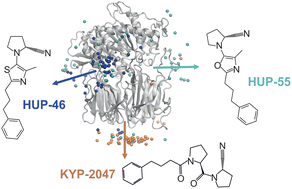
Neurodegenerative diseases, such as Alzheimer's and Parkinson's, pose a growing global health burden. Prolyl oligopeptidase (PREP) has emerged as a potential therapeutic target in these diseases. Recent studies have shown that direct interaction between PREP and pathological proteins, such as α-synuclein and Tau, influences protein aggregation and neuronal function. While most known PREP inhibitors primarily target its enzymatic functions, a new class of ligands, known as HUPs, specifically modulate protein–protein interactions (PPIs), which are crucial in the pathology of neurodegenerative diseases. These structurally distinct ligands exhibit diverse binding behaviors, highlighting the importance of understanding their binding pathways. In this study, we analyzed the binding pathways and stability of structurally diverse ligands using molecular dynamics simulations and enhanced sampling techniques. Traditional inhibitors, such as KYP-2047, target the active site between the catalytic domains of PREP and the β-propeller domain, while HUP ligands bind to alternative regions, such as the hinge site, potentially disrupting non-enzymatic PPIs. Using a PLUMED module called maze, we demonstrated that structural variations among ligands lead to distinct binding and unbinding pathways. Free-energy profiles from umbrella sampling revealed key kinetic bottlenecks and differences in pathway selection. For example, HUP-55 exhibits pathway hopping, characterized by diffuse exploration of binding regions before selecting an exit, while KYP-2047 strongly prefers the central tunnel of the β-propeller domain even under perturbations. These results suggest that the dynamic interaction between ligands and PREP plays a critical role in their mechanism of action. The ability of HUPs to interact with multiple binding sites and adapt to PREP's conformational changes may be essential for their PPI-targeting effects. This work highlights the need to consider both binding pathways and ligand dynamics in the design of next-generation ligands for PREP and related targets.
 Please wait while we load your content...


