


 PLATFORM UPDATE:

Spectroscopic investigations of a pharmaceutical solid form analogue: pyrimethanil l-tartaric acid hemi-cocrystal

Abstract
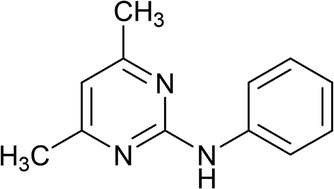
An approach towards pharmaceutical cocrystal analysis is reported for a model cocrystal system of pyrimethanil (an anilinopyrimidine fungicide) and L-tartaric acid (PYL-LTA-CC). Single crystal diffraction studies (X-ray and neutron) show PYL-LTA-CC to crystallise in the primitive orthorhombic space group P21212, with the asymmetric unit (1 : 0.5 stoichiometry) comprising two symmetry independent heterosynthons of pyrimethanil and a half tartaric acid fragment. The neutron diffraction study provides details of the hydrogen bonding in the two adducts and indicates that they are linked by N–H⋯O and N⋯H⋯O hydrogen bonds. Periodic-density functional theory calculations inform on the vibrational properties of PYL-LTA-CC, with the ab initio treatment validated by agreement between simulated and experimental inelastic neutron scattering spectra. Fourier transform infrared spectroscopy in attenuated total reflection mode (FTIR-ATR) and Fourier-transform Raman spectroscopy are used to probe the cocrystal's vibrational transitions. Notable deviations between computed and experimental infrared features are observed at higher wavenumbers, reflecting anharmonic contributions within the hydrogen-bonded network. Although most of the vibrational modes in the FTIR-ATR spectrum provide little direct information on the key hydrogen bonding interactions, a set of deformation modes in the range 1668–1618 cm−1 are diagnostic of distinct hydrogen bonding interactions within the asymmetric unit. The suitability of Raman spectroscopy for identifying hydrogen bonding is also examined, this technique being less information-rich than FTIR-ATR. Collectively, the study demonstrates how vibrational spectroscopy could be used to supplement investigations on the structure and form of the cocrystal as a potential drug delivery vector for this fungicide.
- This article is part of the themed collection: 2025 PCCP HOT Articles
 Please wait while we load your content...


