


 PLATFORM UPDATE:


Probing binding-site preferences in a propiolic acid complex with water at 0.4 K

Abstract
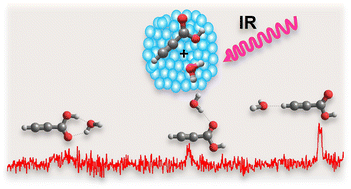
Carboxylic acid⋯water complexes serve as model systems for understanding molecular interactions that are fundamental to bio- and atmospheric chemistry. Utilizing the helium nanodroplet (HND) technique, which enables the kinetic trapping of otherwise inaccessible isomeric structures, we investigated the hydrogen bonding site preferences in a 1 : 1 complex of propiolic acid (HC![[triple bond, length as m-dash]](https://www.rsc.org/images/entities/char_e002.gif) C–COOH, PA) with D2O. Mass-selective infrared (IR) spectra recorded in the C
C–COOH, PA) with D2O. Mass-selective infrared (IR) spectra recorded in the C![[double bond, length as m-dash]](https://www.rsc.org/images/entities/char_e001.gif) O and CC stretching regions confirmed the exclusive isolation of the cis-PA conformer under single-molecule doping conditions of the helium droplets. Further complexation of PA with D2O inside the droplets yielded three distinct isomers of cis-PA⋯D2O dimer, with the dominant spectral features corresponding to two kinetically trapped structures stabilized by either a non-classical (C–H⋯OD2) or a classical (CO⋯DOD) hydrogen bond. A weak IR band corresponding to the global minimum isomer, characterized by a six-membered ring involving D2O and the COOH moiety, is also observed. The structural assignments are aided by harmonic IR spectra of the lowest-energy isomers of PA⋯D2O complexes computed at the MP2/aug-cc-pVDZ level. These structural findings demonstrate the balance of the dipole–dipole and higher-order interactions in steering aggregation dynamics in HNDs. Notably, the polar D2O (μ = 1.85 D) and PA (μ = 1.59 D) promote directional association leading to the formation of local minimum structures, which are lying >20 kJ mol−1 above that of the global minimum isomer. The calculated interconversion energy barriers for cis-PA⋯D2O isomers are in accordance with kinetic trapping inside HNDs at 0.4 K.
O and CC stretching regions confirmed the exclusive isolation of the cis-PA conformer under single-molecule doping conditions of the helium droplets. Further complexation of PA with D2O inside the droplets yielded three distinct isomers of cis-PA⋯D2O dimer, with the dominant spectral features corresponding to two kinetically trapped structures stabilized by either a non-classical (C–H⋯OD2) or a classical (CO⋯DOD) hydrogen bond. A weak IR band corresponding to the global minimum isomer, characterized by a six-membered ring involving D2O and the COOH moiety, is also observed. The structural assignments are aided by harmonic IR spectra of the lowest-energy isomers of PA⋯D2O complexes computed at the MP2/aug-cc-pVDZ level. These structural findings demonstrate the balance of the dipole–dipole and higher-order interactions in steering aggregation dynamics in HNDs. Notably, the polar D2O (μ = 1.85 D) and PA (μ = 1.59 D) promote directional association leading to the formation of local minimum structures, which are lying >20 kJ mol−1 above that of the global minimum isomer. The calculated interconversion energy barriers for cis-PA⋯D2O isomers are in accordance with kinetic trapping inside HNDs at 0.4 K.
- This article is part of the themed collection: Celebrating International Women’s day 2026: Women in physical chemistry
 Please wait while we load your content...


