


 PLATFORM UPDATE:


Ionene-based physical hydrogels: probing the liquid-gel transition, chain and counterion dynamics by means of NMR

Abstract
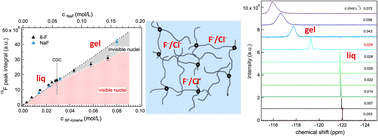
Ionene-based physical hydrogels have been investigated here in terms of the changes of the local environment for ionene polyelectrolyte chains and their counterions upon the liquid-gel transition. These changes were probed via1H and 19F NMR chemical shifts, peak intensities and peak broadening. Further, chain and counterion dynamics was studied by means of PFG-NMR. Properties of ionene-based hydrogels being highly sensitive to the nature of the chain counterion, we compare here two systems, with F− and Cl− counterions. An important observation is the significant loss of signal intensity for the ionene chains and counterions upon the liquid-gel transition. This is a consequence of the immobilisation of a proportion of the chains and counterions as they start taking part in the cross-linked chain network and become invisible to solution/liquid state NMR. For the counterions (measured only in the case of 19F nuclei), the liquid-gel transition leads also to a sudden deshielding effect (peak shift by 3 ppm) and a large increase in the peak width (decrease in the 19F transverse relaxation time). This clearly attests to the involvement of the counterions in the formation of chain cross-links in ionene-based hydrogels. For all solution/liquid and gel phases, the diffusion coefficients of NMR-visible chains are consistently higher in the case of Cl-gels, in comparison to F-gels (a factor of ≈ 2). This reflects the increased rigidity of the F-ionene chains due to strong dissociation of the strongly hydrating F− ions from the ionene backbone.
- This article is part of the themed collection: Celebrating International Women’s day 2026: Women in physical chemistry
 Please wait while we load your content...


