


 PLATFORM UPDATE:


Photoinduced functionalization of graphene with photocleavable coatings
 a
Erich
See,
a
Aleksei
Emelianov,
a
Aku
Lampinen,
a
Maija
Nissinen
*a
and
Mika
Pettersson
*a
a
Erich
See,
a
Aleksei
Emelianov,
a
Aku
Lampinen,
a
Maija
Nissinen
*a
and
Mika
Pettersson
*a
Abstract
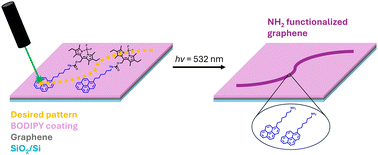
Spatially selective functionalization of graphene has gained interest in recent years due to its ability to create more complex and, at the same time, more controllable materials with added functionalities. Photocleavable protecting groups (PPGs) enable the creation of chemically modified areas on material surfaces by releasing the protected molecules upon exposure to light. In this study, graphene coated with photocleavable boron dipyrromethene (BODIPY) derivatives via non-covalent interactions was patterned with green laser radiation to create amine-functionalized regions on graphene. The tunability of patterning by changing the irradiation time, laser spot size, or anchor group used to attach on graphene was studied. In addition, the topology and thickness of the photocleavable coatings were investigated. Using BODIPY bearing a pyrene anchor, the patterns created on graphene were more precise than with the naphthalene anchor. The photocleavage-created patterns were visible by both atomic force microscopy and Raman mapping. The presented method demonstrates the high potential of non-covalently attached photocleavable coatings for photoinduced, selective functionalization of graphene.
- This article is part of the themed collection: Celebrating International Women’s day 2026: Women in physical chemistry
 Please wait while we load your content...


