


 PLATFORM UPDATE:


Thermodynamic properties of water in aqueous amine solutions studied by energy-representation method
 a
and
Tsuyoshi
Yamaguchi
*a
a
and
Tsuyoshi
Yamaguchi
*a
Abstract
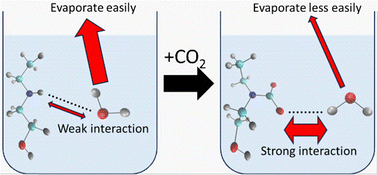
The use of aqueous amine solutions for CO2 capture is considered as a promising strategy for mitigating global warming, and reducing the energy consumption of the capture process is essential for its widespread adoption. Understanding the mechanisms that govern the vapor pressure of water and enthalpy of water vaporization of CO2-loaded solutions can contribute to lowering the energy cost of CO2 capture. In this study, molecular dynamics simulations of aqueous amine solutions before and after CO2 absorption were performed, and the solvation free energy of water was evaluated using the energy representation method. The results revealed that vapor pressure decreases by CO2 absorption, particularly due to the formation of anions that strongly interact with water through hydrogen bonding. The contributions of each solvent species to the solvation free energy and solvation energy were also quantified. It was found that the enthalpy of vaporization increases with amine concentration both before and after CO2 absorption. Before CO2 absorption, this increase is attributed to enhanced energetic interactions, despite the destabilization in solvation free energy due to entropic contributions. Additionally, snapshots indicated water localization in certain systems. Analysis of concentration fluctuations showed that concentration regions with greater fluctuations tended to exhibit smaller changes in vapor pressure with respect to concentration, suggesting a correlation between microscopic structure formation and macroscopic thermodynamic properties.
 Please wait while we load your content...


