


 PLATFORM UPDATE:


Crystal structure and lithium-ion diffusion mechanism in the inverse spinel solid solution series, Li2+xNi2−2xCrxV2O8 (0 ≤ x ≤ 1)
 a
Rebecca
Boston,
a
Babatunde A.
Adedayo,
a
Ronald I.
Smith,
b
Peter J.
Baker,
b
Maria
Diaz-Lopez,
c
Veronica
Celorrio
d
and
Nik
Reeves-McLaren
*a
a
Rebecca
Boston,
a
Babatunde A.
Adedayo,
a
Ronald I.
Smith,
b
Peter J.
Baker,
b
Maria
Diaz-Lopez,
c
Veronica
Celorrio
d
and
Nik
Reeves-McLaren
*a
Abstract
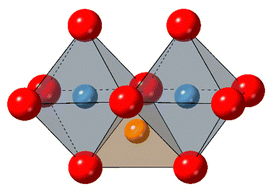
A new solid solution series based on substitution of Cr into LiNiVO4, with the stoichiometric formula Li2+xNi2−2xCrxV2O8 (0 ≤ x ≤ 1), is reported here for the first time. The materials crystallise in the Fd![[3 with combining macron]](https://www.rsc.org/images/entities/char_0033_0304.gif) m space group as inverse spinels, with (at ambient temperatures) vanadium on the tetrahedral site and Li, Cr and/or Ni filling the octahedral interstices. High temperature neutron diffraction data are used to identify a continuous three-dimensional Li+-ion conduction pathway along 16c–8a–16c sites, with bulk activation energies ranging from 0.17 eV for powdered specimens to 0.53 eV for samples sintered at 550–650 °C. Lithium diffusion coefficients at 300 K were calculated from muon spectroscopy data to be in the region of 2 × 10⁻¹² cm2 s−1. Preliminary electrochemical data show significant capacity loss after first discharge when employed as positive electrodes, as is common for similar inverse spinels, but show significant promise for negative electrode applications with ca. 110 mAh g−1 in reversible specific capacity remaining after 50 cycles at an average operating potential of ca. 0.6 V.
m space group as inverse spinels, with (at ambient temperatures) vanadium on the tetrahedral site and Li, Cr and/or Ni filling the octahedral interstices. High temperature neutron diffraction data are used to identify a continuous three-dimensional Li+-ion conduction pathway along 16c–8a–16c sites, with bulk activation energies ranging from 0.17 eV for powdered specimens to 0.53 eV for samples sintered at 550–650 °C. Lithium diffusion coefficients at 300 K were calculated from muon spectroscopy data to be in the region of 2 × 10⁻¹² cm2 s−1. Preliminary electrochemical data show significant capacity loss after first discharge when employed as positive electrodes, as is common for similar inverse spinels, but show significant promise for negative electrode applications with ca. 110 mAh g−1 in reversible specific capacity remaining after 50 cycles at an average operating potential of ca. 0.6 V.
 Please wait while we load your content...


