


First-principles investigation of lithium ion first-in-first-out behavior during delithiation and lithiation processes in Li2MnO3 lithium-rich cathode materials
 *a
*a
Abstract
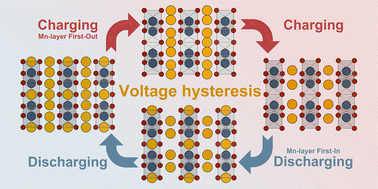
Lithium-rich manganese-based cathode materials have attracted significant attention due to their high capacity potential and the involvement of oxygen anions in redox reactions. However, their practical application is severely limited by the persistent voltage hysteresis observed during the charge–discharge cycles. To uncover the fundamental mechanism behind this phenomenon, this study employs first-principles calculations based on density functional theory to systematically investigate the thermodynamic stability and kinetic behavior of lithium migration during the delithiation-lithiation process. In a novel approach, the redox reaction is decoupled into two distinct stages: lithium-ion migration and electron transfer. Electron-deficient and electron-enriched models were constructed to simulate the electrochemical directionality of charging and discharging, and the migration pathways and energy barriers of lithium ions in different configurations were calculated. Combined with Bader charge analysis and density of states calculations, the results reveal that lithium ions preferentially migrate from the transition metal layer, exhibiting a clear “first-in-first-out” kinetic behavior. This asymmetric migration leads to mismatched charge–discharge pathways, which is identified as the root cause of voltage hysteresis. These findings provide atomic-scale insight into the origin of voltage hysteresis, offer a new theoretical perspective on the nonequilibrium structural evolution of lithium-rich materials, and lay a solid foundation for the rational design of next generation high energy density cathode materials with improved electrochemical performance.
 Please wait while we load your content...


