


 PLATFORM UPDATE:


Potential energy surfaces: Δ-machine learning from analytical functional forms
 *a
and
Joaquin
Espinosa-Garcia
b
*a
and
Joaquin
Espinosa-Garcia
b
Abstract
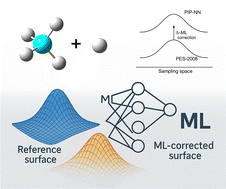
Delta-machine learning (Δ-ML) is a highly cost-effective approach for developing high-level potential energy surfaces (PESs) from a large number of low-level configurations. In particular, the high flexibility of the analytical potential energy surface developed previously by our group is exploited to efficiently sample points from the low-level data set and, using information from the highly accurate permutation invariant polynomial neural network (PIP-NN) surface, construct the Δ-ML PES. This approach is applied to the well-known H + CH4 hydrogen abstraction reaction. In order to test the validity and accuracy of the approach to describe this polyatomic system, kinetic studies using the variational transition state with multidimensional tunneling corrections and dynamic studies on the deuterated reaction, H + CD4, using quasiclassical trajectory calculations were performed on three surfaces. The delta-machine learning approach reproduces the kinetics and dynamics information of the high-level surface, showing its efficiency in describing multidimensional polyatomic systems.
 Please wait while we load your content...


