


 PLATFORM UPDATE:


Metal coordination-driven photochromism in Schiff bases incorporating 1,2,4-triazole and hydroxyphenyl moieties

Abstract
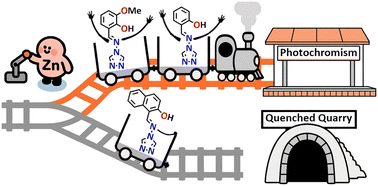
Solid-state photochromism is often suppressed in organic crystals by packing constraints. Herein, we report the coordination-driven activation of pronounced photochromism in a series of zinc(II) complexes with N-substituted 4-amino-1,2,4-triazole ligands. X-ray crystallography shows that coordination to Zn(II) disrupts the ligands' inherent intermolecular hydrogen bonds, locking them into a conformation favorable for excited-state intramolecular proton transfer (ESIPT). Diffuse reflectance spectroscopy confirmed UV-induced photochromism in four of the five synthesized complexes. A quantitative energy analysis of intermolecular interactions, combining Hirshfeld surface analysis and QTAIM, identified π–π stacking as the key modulator: the only non-photochromic complex in the series served as a key example, exhibiting the strongest stacking interactions. We conclude that metal coordination provides the structural prerequisite for ESIPT, while the specific supramolecular packing, particularly the strength of π–π stacking, ultimately gates the photochromic response. This work illustrates the potential of metal coordination as a tool for engineering photochromic behavior in crystalline materials.
 Please wait while we load your content...


