


 PLATFORM UPDATE:


CVD growth and width-dependent optical properties of spiral WS2 microribbons on 2D triangular monolayer WS2 flakes

Abstract
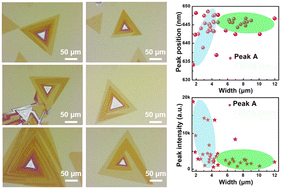
Two-dimensional (2D) layered transition metal dichalcogenides (TMDCs) can form spiral structures via a screw-dislocation-driven mechanism, which leads to changes in their crystal symmetry and layer stackings that generate attractive physical properties different from their bulk and few-layer crystals. However, the controllable growth of 2D spiral TMDC crystals is still challenging, and the width-dependent optical properties of these spiral structures with different widths need to be further studied. Here, we report the controllable growth of high-yield 2D spiral WS2 flakes through a chemical vapor deposition route via utilizing spin-coated Na2WO4 and Na2MoO4 powders as the precursors. Systematic characterizations elucidated that these 2D spiral WS2 flakes consist of triangular monolayer flakes as the bottom part and spiral microribbons with different widths as the upper part, and the microribbons stacked on the triangular monolayer flakes present a width-dependent optical performance. Finally, the growth mechanism of these unique structures is ascribed to the existence of screw dislocations. These spiral TMDC structures are prospective candidates for probing the physical properties of layered materials and exploring novel applications in functional nanoelectronic and optoelectronic devices.
 Please wait while we load your content...


