


 PLATFORM UPDATE:

Efficient capture of Sr2+ ions by a layered crystalline zirconium phosphate fluoride

Abstract
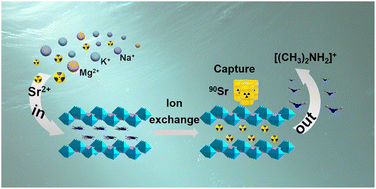
The effective remediation of radioactive strontium-90 (90Sr) from complex aqueous environments remains challenging due to the inherent high solubility and migration propensity of Sr2+ ions. Herein, we synthesized hydrothermally a new two-dimensional (2D) crystalline zirconium phosphate fluoride [(CH3)2NH2][Zr(PO4)F2] featuring a layered anionic architecture of [Zr(PO4)F2]nn− with intercalated [(CH3)2NH2]+ cations, which shows exceptional Sr2+ remediation capability. It possesses a high maximum Sr2+ adsorption capacity (qSrm) of 161.48 mg g−1 (higher than that of many inorganic crystalline adsorbents) and fast kinetics for Sr2+ capture (Sr2+ removal rate (RSr) of 94.89% within 1 min). Specifically, it maintains Sr2+ removal efficiency in the presence of competing Cs+, K+, Na+, Ca2+, Mg2+ ions and in actual aqueous systems including seawater (RSr = 79.06%). X-ray photoelectron spectroscopy (XPS) and thermodynamics confirm that spontaneous Sr2+ capture occurs through ion exchange processes, where the interlayered [(CH3)2NH2]+ cations in [(CH3)2NH2][Zr(PO4)F2] are exchanged with Sr2+. The compound [(CH3)2NH2][Zr(PO4)F2] represents the first crystalline inorganic zirconium phosphate fluoride ion exchange material for radionuclide capture. This work provides a high-performance ion exchanger as a candidate for radiostrontium capture.
 Please wait while we load your content...


